
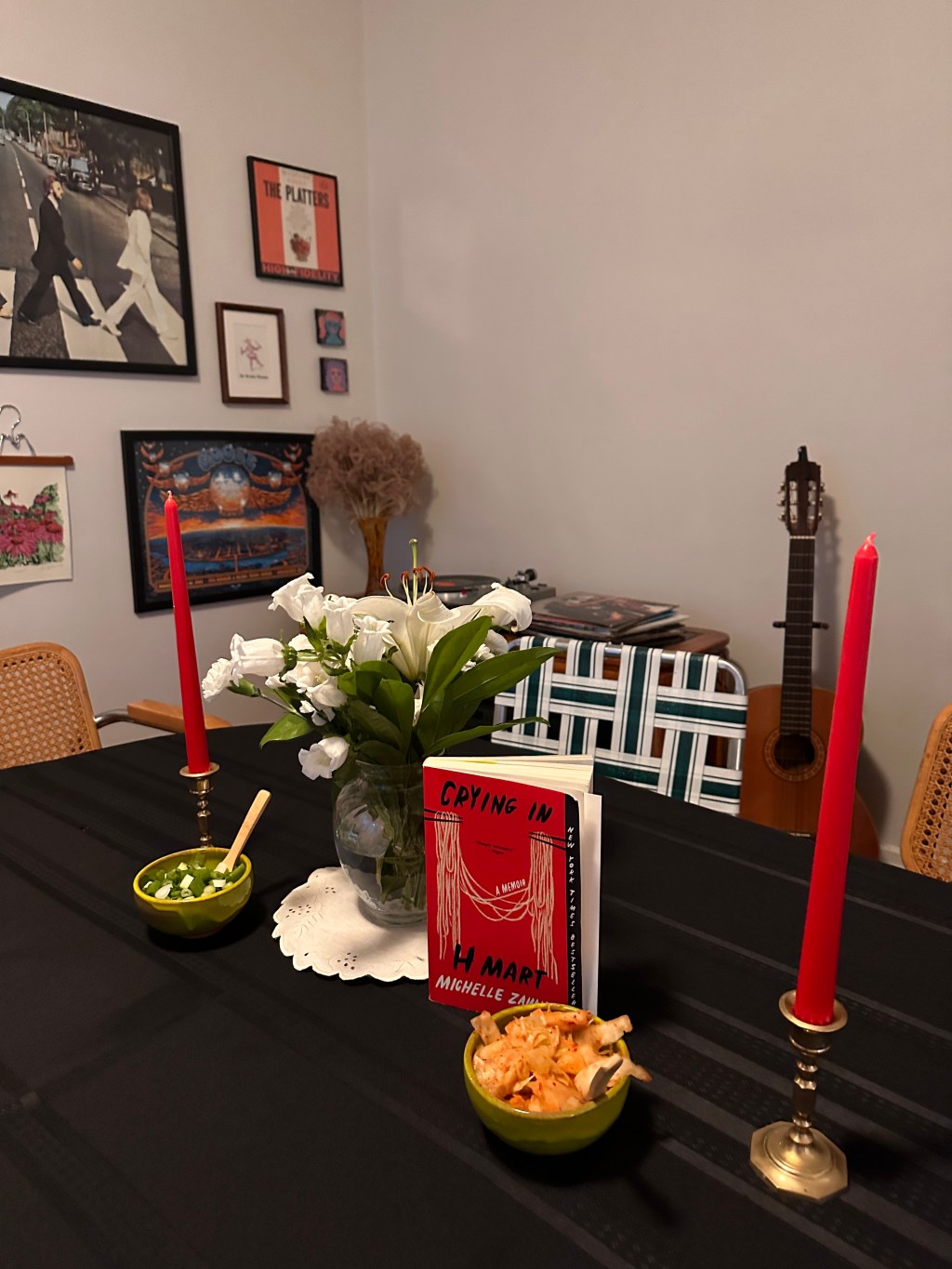
It was my pick for book club this month. I chose Crying in H Mart, a memoir where Michelle Zauner explores the grief around her mother’s death and their relationship through food.
The day of book club, my mom, aunts, and cousins were set to arrive at 5pm. That morning I went into the Yao Lee Asian Supermarket with a list of ingredients written down– determined to make doenjang-jjigae (fermented soybean paste stew), a classic Korean comfort food. I followed Maangchi’s recipe like she does in the book, but I followed Zauner’s lead to sub shrimp for short rib.
Jake and I went into the market, wandering aimlessly, hypnotized by the rows of snacks and ingredients we didn’t understand. Though they kindly had English labels on the shelves, we didn’t know where anything was.
A man, who I assumed owns the store, approached me and offered to help hunt down the items on my list.
Dried anchovies, check. Chili peppers, check. Fermented soybeans, check. Gochugaru (Korean chili powder), check.
As we checked out, the man asked, “Who’s the cook?”
“I am, today” I replied.
“He looks like a good helper,” he nodded towards Jake who was juggling the ingredients from his arms onto the belt.
I told him about the dish I was planning to make for my book club and asked if he had anything good for dessert.
“Egg tart,” he said. “This one behind you, my wife makes fresh every weekend.”
Seven egg tarts later, we left with smiles on our faces, holding a blue handwritten coupon for $4 off our next visit.
At home, Jake was more than just a helper. As I prepped all of the elements of the stew, he cooked marinated short rib, the one ingredient Yao Lee did not have.
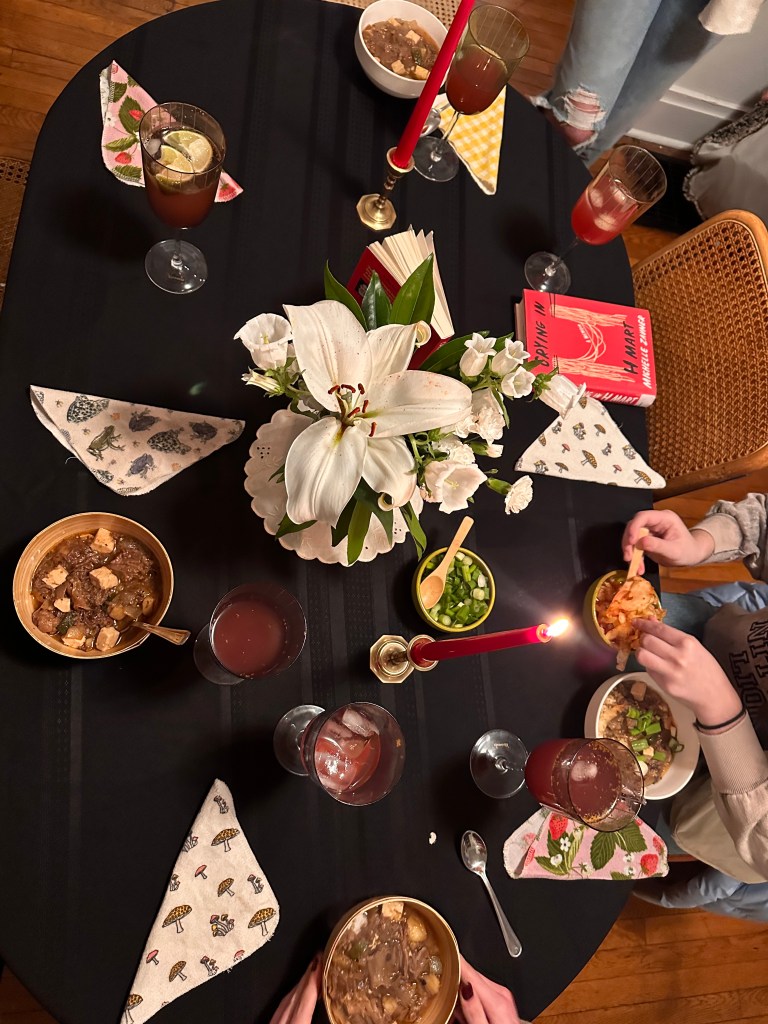
At 5pm, my family started to arrive, red candles lit, the house smelling of beef and onions. We spooned our stew over small piles of rice, topping it with kimchi and green onions.
All of us, even the pickiest eater, enjoyed it (I didn’t tell her about the dried anchovies until after).
During our discussion, we talked about something Zauner’s mother would say to her:
Some of the earliest memories I can recall are of my mother instructing me to always “save ten percent of yourself.” What she meant was that, no matter how much you thought you loved someone, or thought they loved you, you never gave all of yourself. Save 10 percent, always, so there was something to fall back on. “Even from Daddy, I save,” she would add.
Crying in H Mart, pg. 18
Reading this made me sad for her mother. It made me feel as if she lived her whole life holding back a piece of herself.
To me, giving 100% is your willingness to fully be hurt, completely vulnerable. To some that may be a bad thing. To most, it’s terrifying.
It’s natural to want to protect ourselves from things that could go wrong. When we “overthink”, we never imagine the amount of potential positive possibilities, but instead we spiral over the negative ones. We like to prepare for the worst.
But in life, in relationships, is saving some of ourselves holding us back from real friendship, love, and connection? Or is it just smart? Because at the end of the day, all you have is yourself.
Do we want a piece that is just ours? But maybe all of the pieces still are. Letting people in doesn’t have to mean giving up those parts of ourselves.
Zauner then writes about her mother’s high expectations, which reminded me of my own childhood in some ways:
She applied the same fastidiousness to the household, which she kept
Crying in H Mart, pg. 20
immaculate…Sometimes, when my parents would leave me at home with a sitter, I would line up her figurines on a serving tray and cautiously wash each animal in the sink with dish soap, then dry them off with paper towels…hoping my mother would return and reward me with affection.
As Zauner described her mom in these pages, I saw mine, assembling in perfect clarity in my memory, pushing the vacuum with vigor across our cream carpet, making sure the lines were straight like a professional landscaper does with grass.
During the summer, my mom worked all day leaving my sister and I with a daily Post-it listing any chores to complete that day.
We squeezed our chores in between episodes of Pretty Little Liars streamed from our Wii and hours floating down the lazy river at the Groveport Aquatic Center.
Even though we’d tackled our Post-it, when mom was on her way home, we scurried around the house to prepare for her arrival. We took stuff to our room from our stair piles and fluffed pillows as if we weren’t couch potatoes at some point that day.
When she got home, we’d tell her everything we did to see her smile and say, “Thanks, girls.”
At 25, I still find myself constantly resetting my space. Everyday I come home, my eyes scan the room looking for things that are out of place. Adjusting coasters. Fixing the couch cushions. Sometimes, I do a full scan before I’ve even greeted Jake, just depending on the mood I’m in.
The way my mom treated our home taught me that keeping a space neat can help declutter your mind. I feel at peace when things are clean.
But one thing I’m still learning is that it’s okay to let go a little bit. It’s okay for my apartment to look slightly lived in and to maybe leave a few dishes in the sink once in a while.
I realize that both excerpts I chose for this post were from the first 20 pages of the book. The rest is definitely worth reading, but you’ll get no spoilers from me.

 diary of a 20 something
Leave a comment